Why Carpentersville Homes Cost Less Than Algonquin's, and What Changed This Year
August 27, 2026
August 27, 2026
A buyer comparing Carpentersville to Algonquin on paper sees a gap that looks almost too large to make sense. In February 2026, homes in Carpentersville sold for a median of $280,000. Three towns over, Algonquin buyers were paying a median of $415,000 for homes sold in the three months ending that April. Same county corner of the Fox Valley, similar housing stock, and a six-figure difference sitting between them.
The instinct is to assume the houses are worse. They mostly aren't. What's actually separating these two markets has less to do with square footage and more to do with a 70-acre hole in the ground that, until last year, had a dead mall sitting on top of it.
Pull the price-per-square-foot number and the story gets more interesting. Carpentersville's median sale price per square foot in February 2026 was $209, up 13 percent year over year. Algonquin's, over the three months ending in April, was $200, up 1.5 percent. On a pure construction-and-condition basis, the towns are within a few dollars of each other. The $135,000 gap in total price is coming almost entirely from home size, lot size, and the mix of what's for sale, not from Carpentersville selling inferior square footage.
| Metric | Carpentersville | Algonquin |
|---|---|---|
| Median sale price | $280,000 (Feb. 2026) | $415,000 (3 mo. ending Apr. 2026) |
| Price per square foot | $209 | $200 |
| Year-over-year price change | +11.1% | +0.9% |
| Days on market | 83 (vs. 47 a year earlier) | 68 (vs. 55 a year earlier) |
| Homes sold in period | 17 (down from 22) | 118 (up from 88) |
Two things jump out. First, Carpentersville prices are rising more than ten times faster than Algonquin's, even from a much lower base. Second, Algonquin's market is deeper and faster, with sales volume climbing while Carpentersville's shrinks. That combination, thin supply plus sharp price growth, usually means a market that's repricing something specific rather than just following the regional tide. In this case, the something specific has a name: Spring Hill Mall.
Spring Hill Mall opened in 1980 straddling two municipalities, with roughly 80 percent of the property in West Dundee and the remaining 20 percent, including the former Carson Pirie Scott and Kohl's locations, inside Carpentersville. For most of its life it anchored the Route 31 corridor that runs through both towns and connects them to the Fox River.
Then the anchors started leaving. Sears closed in February 2020. Macy's closed that same year. Barnes & Noble eventually relocated to Algonquin Commons. By the time the mall permanently closed in March 2024 after 44 years, Cinemark was the only tenant left operating on the site.
A dying regional mall doesn't just sit there quietly. It becomes an unresolved question mark for everyone nearby, including the two villages that share its property line and, by extension, anyone weighing a home purchase along that stretch of Route 31. Any agent who's worked this corridor over the past decade has watched buyers hesitate at a mall with five vacant anchor boxes and no clear future. That hesitation shows up in comps eventually, even without a single line item that says so.
Here's the part that explains why the situation dragged on for so long and why it just recently stopped. A struggling mall with multiple owners is genuinely hard to fix through the private market alone. Different landowners hold different parcels, each with its own covenants, financing, and incentives, and none of them is obligated to act on anyone else's timeline. That gridlock, not lack of interest, is often what keeps a dead property dead for years.
West Dundee broke that gridlock by buying it. The village spent more than $13 million to acquire the mall from its various owners and clear it for redevelopment. A TIF district works by freezing the taxable value of a designated area at its current, depressed level. As redevelopment raises that value over time, the difference, the increment, gets redirected toward repaying the public investment rather than immediately flowing to schools, parks, and other taxing bodies. It's a way to front costs a private buyer wouldn't take on, in exchange for capturing the upside later. Carpentersville itself designated a portion of the mall as a TIF district back in January 2016, and separately runs a broader, 397-acre Old Town Redevelopment TIF District covering more of the Route 31 corridor.
Carpentersville handled its own slice of the mall separately, agreeing in 2025 to buy the former Kohl's parcel within its borders for $2 million. Demolition of the enclosed mall wrapped up ahead of schedule in late 2025. West Dundee's Village President Chris Nelson called it hitting a milestone earlier than anticipated, and West Dundee's Village Manager Joe Cavallaro described what remained afterward as a blank slate for the nearly 70 acres in the center of the village.
This is the point where a buyer should slow down rather than get ahead of themselves. In June 2026, West Dundee trustees got their first look at concept designs from Houseal-Lavigne Associates, a Chicago planning firm, showing what a mixed-use, walkable town center could look like on the former mall footprint. Village officials were direct that this is marketing material meant to signal openness to development, not an approved project with financing behind it. West Dundee has also set aside roughly 4 acres of the site for a new public safety building, since its police and fire departments currently share a facility built in 1986, but that's a municipal use, not private redevelopment.
No developer has broken ground. No retail, dining, or housing component on the former mall site has a construction date. If you're comparing Carpentersville to Algonquin today, the honest read is that the corridor's biggest liability has been removed, but its next chapter hasn't been written yet.
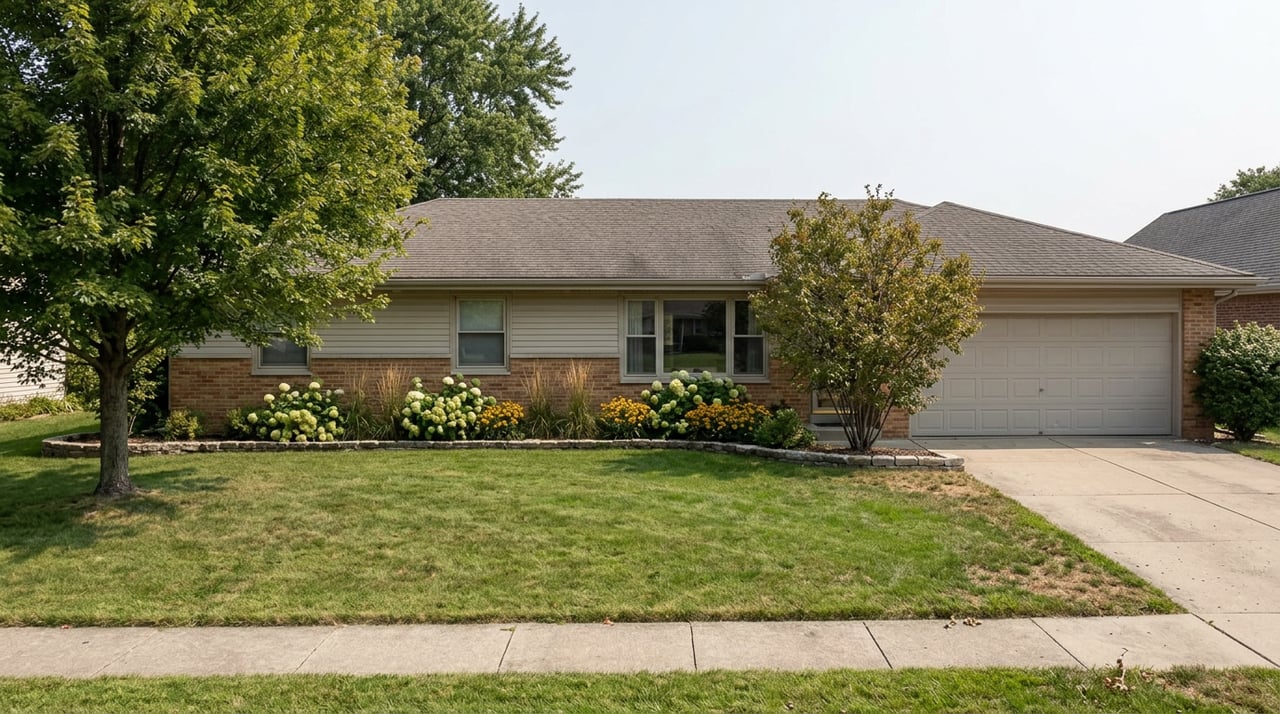
For a buyer priced out of Algonquin's $415,000 median, Carpentersville offers genuinely comparable housing at a meaningfully lower entry point. The stock is similar: ranch-style homes, Colonial Revival houses, newer traditional builds, and a scattering of custom construction, with single-family homes making up the bulk of the market and townhomes and condos filling out roughly a third of it. Local listings this year have spanned roughly $226,000 for townhomes up to $1.25 million for larger single-family homes.
What you're buying into is a corridor in transition rather than a corridor with an unknown future. The demolition and the TIF-backed cleanup already happened. The price appreciation data, 11.1 percent year over year against Algonquin's 0.9 percent, suggests the market has started pricing in that change even before a single new building goes up. That's worth taking seriously if you're deciding between these two towns on value alone. It's also worth tempering with a plain fact: concept renderings are not permits, and permits are not move-in dates. Anyone buying today should do so because the house and the price work for them now, not because of what might eventually rise on Route 31.
Will the TIF district raise my property tax bill? Not directly. A TIF freezes the base value used for other taxing bodies within the district and redirects the increment above that base toward repaying redevelopment costs. Your individual tax rate isn't set by the TIF itself, though it's a mechanism worth understanding if you're buying inside one of Carpentersville's TIF boundaries. Ask your agent or the village for the current district map before you assume anything about your specific parcel.
When will something actually get built on the old mall site? As of the concept designs shown in June 2026, there's no construction timeline. The presentation was described as a starting point for developers, not a funded project.
Is the price gap between the two towns going to keep closing? The direction of travel favors it, based on the appreciation rates in the data above, but the dollar gap remains large and nothing about a conceptual redevelopment plan guarantees a specific outcome or timeline.
If you're weighing Carpentersville against its pricier neighbors and want to talk through what a given block or parcel is actually worth right now, Swanson Real Estate, Inc. has been reading the Fox Valley's price signals for decades. Contact Us when you're ready to look at real numbers instead of guesses.
Stay up to date on the latest real estate trends.
We pride ourselves in providing personalized solutions that bring our clients closer to their dream properties and enhance their long-term wealth.